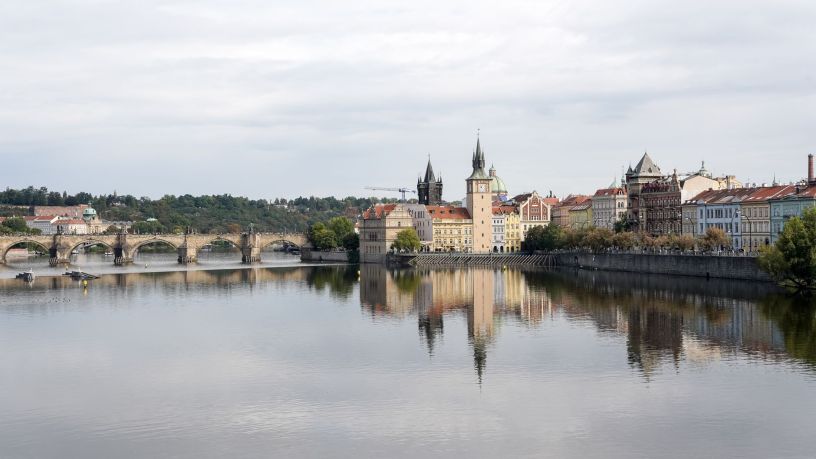
The language we call Irish arrived here as the native tongue of migrants from what is now Czechia, a study by geneticists, historical linguists and archaeologists has shown.
Some experts believed the roots of Irish lay along Europe’s western Atlantic coast, but a study published in the journal Nature, which analysed DNA from the remains of 4,587 ancient people, suggests it was 1,500km away.
In prehistory, Celtic languages were common across Europe.
Researchers believed that any of three known prehistoric migrations from continental Europe could account for their arrival in Britain and Ireland, but found the most recent – a westward movement of people from an area that is now Czechia, between 3,200 and 2,800 years ago – best fitted the genetic data from their study.
“The last one actually seems the most attractive because it goes to all the areas in which Celtic languages are historically spoken,” said Dr Guus Kroonen, a historical linguist at Leiden University and the University of Copenhagen, who jointly led the research effort.
The timing of that migration, he said, matches the timing for when linguists believe the Celtic language first emerged and spread. These migrants were part of the Urnfield culture, named for cremating their dead and burying the ashes in urns.
“The ancestry of the people that lived in Czechia around 1200BC is the ancestry that spreads all across Europe, including to the British Isles and Ireland,” Dr Kroonen said.
For over a century, experts mostly believed Celtic language first arose among seafaring communities along the Atlantic coast, linking Ireland, Britain, France and Iberia.
This was supported by historical accounts in Lebor Gabála Érenn (The Book of Invasions), a medieval book stating that the Milesians – the name its authors gave to the last people who migrated to Ireland – had arrived from Spain.
“The genetics do find some support for this,” said Dr Kroonen. “But this wave is not as strong, and it doesn’t reach all of the areas in which Celtic languages were spoken.”
Dr Hugh McColl, a geneticist at the University of Copenhagen and the study’s other joint lead, sought to clarify matters by analysing ancient DNA from the skeletons of ancient people sourced across Europe, sometimes in museums, with samples often taken from the well-preserved inner ear bones.
“By recovering ancient DNA from skeletons across Europe, we were able to detect who was related to who through time,” Dr McColl said. “We detected people moving from central Europe 3,000 years ago to the British lsles.”
The study reveals Irish people today are more related to central European people than was thought, Dr Kroonen said, and carry the genes from people who arrived in Ireland from places even farther to the east – the Eurasian Steppe –about 4,500 years ago.
The authors cautioned that ancient DNA cannot prove what language anyone spoke, as language does not always move with genes.
“That would be kind of magic,” Dr Kroonen said.
In the ancient world, Celtic languages were common in Europe, spoken by people from Portugal to Turkey.
As the Roman Empire expanded, the Celtic-speaking people on the Continent were increasingly squeezed by Romans from the south and Germanic tribes pushing from the north.
Celtic-speaking Irish people were not subject to such pressures.
“That isolation helped preserve a language whose story began deep in the heart of the Continent,” Dr Kroonen said.
Published in the Irish Independent 04.11.2026

