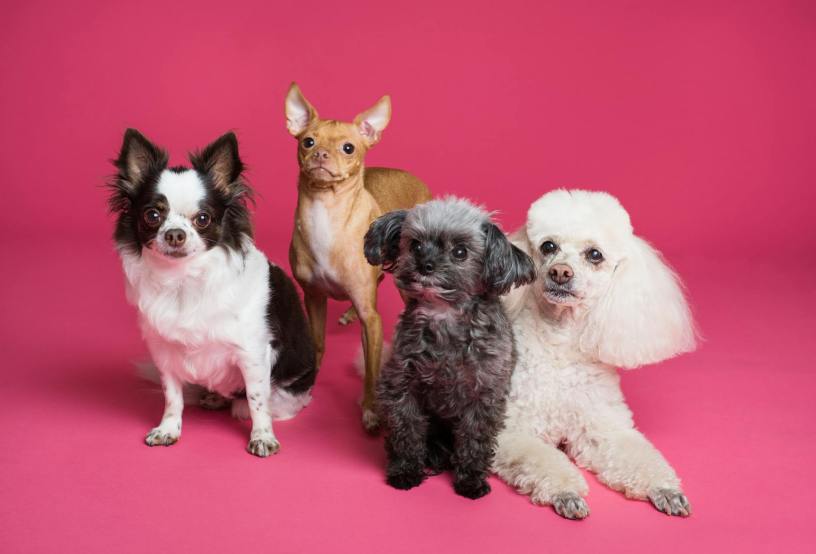
A new global study has upended previous assumptions about dogs’ widely varying characteristics
The origins of the incredible variety in dog species, from Great Danes to chihuahuas, did not begin, as previously thought, with selective breeding efforts by the Victorians.
Ruth Carden, a senior fellow at the Atlantic Technological University (ATU), said researchers had assumed that the many breeds of dogs, with different skull and body sizes and shapes, had developed as a result of breeding in Victorian kennel clubs about 200 years ago.
But new research, which she was part of and which has been reported in Science, goes against this theory.
She explained: “Our study shows this is not the case, and the significant shape changes to dogs’ skulls occurred much earlier – around 11,000 years ago.
“These changes have been shaped by evolution since splitting from wolves and the domestication of dogs. Adaptation to local environments and … their companionship with people caused the rapid change in dog skull shapes.”
It is remarkable, when we look at dogs today, to consider that all of them, scientists believe, are descended from a single ancestor: the wolf.
For the study, scientists in 40 institutions around the world examined 643 dog skulls.
The skulls were from street dogs, recognised breeds, and specimens recovered from archaeological excavations spanning the last 50,000 years.
Advanced techniques were used to reconstruct the skulls and measure how the shapes changed over that period of time.
The findings clearly showed that dog diversity began thousands of years before the Victorians.
Researchers found evidence that dogs are descended from two ancient wolf populations – one in Asia, the other in the Middle East or Southern Europe.
The gene IFT88 is thought to have helped dogs adapt to different climates and prey.
The earliest evidence of domesticated dogs in the study was traced to a site at Veretye, Russia, a tiny village in Vologda Oblast, near the Finnish border.
Dr Carden studied three Irish dog skulls as part of the global study: one from a modern German mastiff, and two recovered from excavations at Lough Gur, Co Limerick, and Dunshaughlin, Co Meath.
The shape of the archaeological specimens analysed by Dr Carden, which had both been originally catalogued by researchers as dogs, revealed them to be ancient wolves, albeit smaller than their modern relatives.
“This was a surprising result,” said Dr Carden. “The Irish samples, while a small part of a huge dataset, matter, because every intact skull from the archaeological record helps tease out the early story.”
Meanwhile, analysis of ancient DNA from wolf remains found in caves at Kesh Corran, Co Sligo, and Ballynamintra, Co Waterford, is helping scientists better understand the history of dogs on this island.
As a next step, Dr Carden wants to discover when and how the first dogs reached Irish shores.
“We’re analysing skulls, DNA and origins data, and hope to share real answers by next year,” said Dr Carden.
 Science Spinning