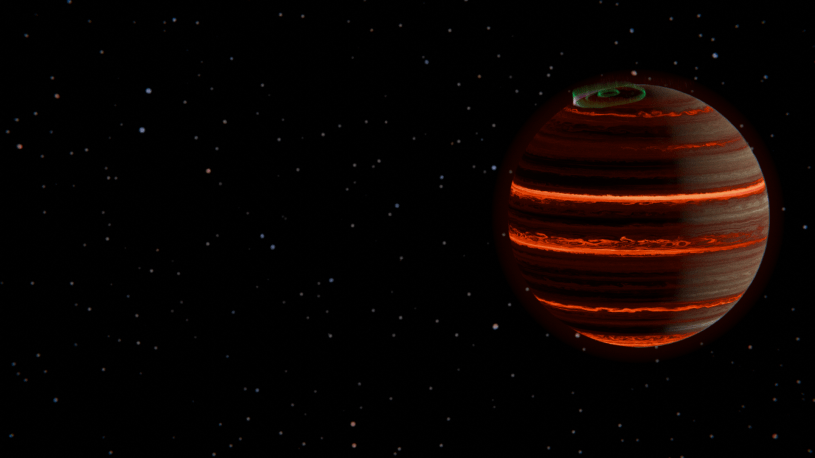
Astronomers at Trinity College Dublin have discovered ‘Northern Lights’, similar to those seen on Earth, around a distant planet 20 light years away.
A team led by Johanna Vos, Associate Professor of Physics at Trinity College Dublin (TCD), has found an ‘aurora’ around a planet called SIMP-0136, using the powerful James Webb Space Telescope (JWST).
“These are some of the most measurements of the atmosphere of any extra-solar object to date, and the first time that changes in the atmospheric properties have been directly measured,” said Dr Evert Nasedkin, a Postdoctoral Fellow in the TCD School of Physics, and the lead author of the new research.
An aurora, on Earth, is a natural light display in the sky, seen at high and low latitudes. The effect is caused by collisions of charged particles from the Sun with atmospheric gases near the poles.
It produces the spectacular green and reddish ‘Northern Lights’ sometimes visible in Donegal, and the lesser known ‘Southern Lights’.
“We suspected that there was an aurora on SIMP-0136 from earlier radio observations, but we didn’t anticipate being able to confirm it with the JWST,” said Professor Vos.
“What we found was that the precision of the JWST allowed us to make very good measurements of how the temperature changes at different altitudes in the atmosphere (of SIMP-0136).
“Similar to here on Earth, we expected the atmosphere to become colder at higher latitudes. Instead, we found that at some point the atmosphere started becoming warmer again, which we are only able to explain by heating from an aurora.”
Scientists believe temperatures existing on SIMP-0136 are over 1,500 Celsius, but despite this, Prof Vos was able to capture small changes, less than 5 Celsius, in the planet’s atmosphere.
“These changes in temperature were related to subtle changes in the chemical composition of this free-floating planet, which is suggestive of storms – similar to Jupiter’s Great Red Spot,” said Prof Vos.
Another surprise was the constant cloud coverage, unlike Earth, where there are patches of clouds mixed with clear blue sky.
On Earth, clouds are made up of tiny liquid water droplets and ice crystals, but on SIMP-0136 Prof Vos believes, from observations, that they are made up of silicate grains, like sand.
The Exo-Aimsir Group, led by Prof Vos and including PhD candidates Merle Schrader, Madeline Lam and Cian O’Toole was set up to better understand weather on exo-planets beyond our Solar System.
More than 6,000 such exo planets have been discovered since the first pair were confirmed in 1992.
But, why are such studies relevant to our lives here on Earth?
“For several reasons,” said Prof Vos.
“The first is the economics of it: basic research into astronomy can lead to unexpected technological advancements, from WIFI, to microwaves to GPS satellites and digital cameras.
“I think it’s important to ask big questions, and to understand the world and universe that we live in.
“This is really just the beginning of understanding the weather on other worlds.
“We could see how things change as SIMP-0136 rotates, but in the long term we want to understand the atmospheric dynamics.
“Are there stable storms like the Great Red Spot on Jupiter? Does it have bands and spots, or does it look different to anything in the Solar System,” she continued.
“We’ve always wondered if we’re alone in the Universe and studying these atmospheres is one step on the path to answering that question.”
The research is published today in the journal Astronomy and Astrophysics.
 Science Spinning