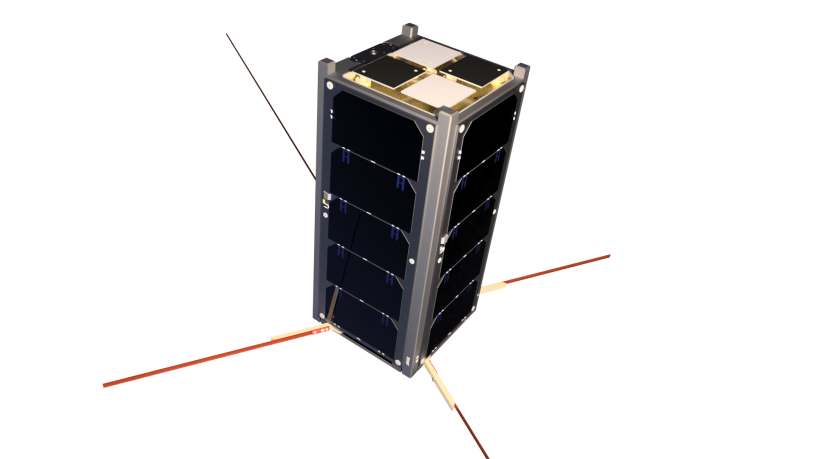
Eirsat-1 was built by UCD staff and students, as part of an educational programme by the European Space Agency
The first fully Irish-designed satellite is set to fall out of orbit this week and disintegrate in the atmosphere, marking the culmination of pioneering UCD-led project that has advanced science.
Eirsat-1 has nurtured a generation of home-grown space experts who have gone on to work in industry.
The satellite was built by UCD staff and students, as part of the ‘Fly Your Satellite’ educational programme by the European Space Agency (ESA).
It was launched on December 1, 2023, onboard a Falcon 9 rocket from the Vandenberg Space Force Base in California, and entered its low Earth orbit later the same day.
“Our students have learned incredible skills,” said Professor Lorraine Hanlon, head of the UCD Space Technology Group, a research team focused on spacecraft and space technology.
“We’ve had about 50, mainly postgraduate students in physics and engineering who have worked on the project,” Prof Hanlon said.
“Several of them are now working in Irish space companies, and we’re now collaborating with them on new projects.”
If approved, this would see Ireland at the forefront of complex space science missions
The Eirsat-1 is about the size of a shoebox, has an aluminium body, is fitted with solar panels on all sides, and featured a gamma-ray detection experiment. Its success has been “transformational” Prof Hanlon said, “not just for UCD, but for the country”.
One impact of Eirsat-1 is it led to an Irish proposal to develop 28 spacecraft with gamma ray instruments now being considered by ESA.
“If approved, this would see Ireland at the forefront of complex space science missions in the coming decade,” Prof Hanlon said.
“It’s been great for us on the astrophysics side. We’ve taken an idea that we had more than 10 years ago, and gone from that basic idea to a fully space qualified, successfully operating space instrument.”
We are building up capabilities for next generation satellite communications
The success also has also transformed the space-based SMEs now located in Galway, Cork, Dublin and elsewhere around Ireland and given them the confidence to take the lead in space technologies.
“We are building up capabilities for next generation satellite communications, using high-speed links provided by big lasers,” Prof Hanlon said.
“That’s going to be a big breakthrough because in space an issue is the limited bandwidth available to download a huge volume of data produced using certain applications.”
Irish companies are looking at ways to use technology to sift and analyse data gathered by the satellite before determining what needs to be downloaded at any particular time.
“People are using AI on board the satellite to be more efficient and clever, and more responsive about the data you send out,” Prof Hanlon said.
The UCD team have been monitoring the satellite as its altitude has steadily declined over recent weeks. Once it drops down below about 300km, it will start to burn up, and vaporise.
“It’ll completely burn up in the atmosphere, it’s not going to land on anything,” Prof Hanlon said.
 Science Spinning