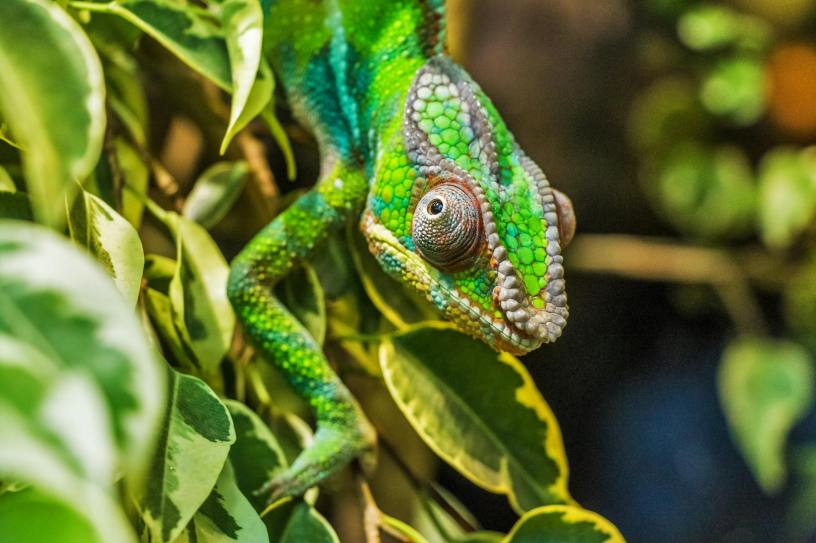
Nature’s ability to make a biological feature, like a feather, appear to change colour when seen from a different angle has been recreated by TCD scientists.
Some 500 million years ago, nature evolved the ability to generate vibrant colours that meant biological features like feathers, wings and shells could reflect light in ways that made colour appear different from different angles.
Up to now, researchers were unable to replicate how nature did this in the lab.
“We have managed to exploit how nature creatures structural colour, like that found in chameleons, birds and fish,” said Professor Colm Delaney, from the TCD School of Chemistry and the Amber Research Ireland Centre who led research reported today in the journal Advanced Materials Science.
When we think of how colour is generated, many of us might think of natural pigments, like chlorophyll which makes many plants green, or carotenoids, which make carrots red, or flavonoids, which make blueberries blue.
Yet, there is another way that nature generates colour. This is when colour is produced as a result of how something is physically made and then how it interacts with light. This is called ‘structural colour’, and it can be changed in a split second to camouflage an animal, make it stand out, or even disappear.
“Colouration in nature is achieved in three ways; pigments, bioluminescence and structural colour,” said Professor Delaney. “Structural colouration is used for camouflaging, signalling, mimicry, distraction, and energy harvesting.”
“We think of structural colour as something exotic, found in chameleons, birds of paradise, but it’s also on our doorstep,” said Prof Delaney.
“For example, two native, iridescent species, Mint Leaf Beetle, and Green Tiger Beetle display beautiful structural colour.”
Prof Delaney’s team used nanomaterials – tiny subatomic materials – capable of self-assembly using a stimulus like heat, to mimic nature’s colouring work.
Nanomaterials, Prof Delaney said, prefer order over disorder so they will build orderly systems and create the maximum free space possible in a system. This creates beautifully ordered structures that pack together like stacked oranges.
At this point microfabrication – the process of creating miniature structures and devices – is deployed to move particles closer or further apart, resulting in different possible reflected colours that can be seen off a single material.
Materials that can change colour can be used, said Prof Delaney, in sensors for measuring changes in glucose levels, acidity, temperature or pressure. The colour changes can be easily measured using a mobile phone, or even by eye.
This work, which has been funded with a European Research Council Starting Grant, could transform environmental sensing and biomedical diagnostics.
The TCD team are part of the IV-Lab Project, a European project led by the Italian Institute of Technology which aims to develop implantable devices that are capable of tracking chemical changes happening inside the human body.
“The IV-Lab Project will develop a multi-sensing device implantable into blood vessels, such as peripheral veins or arteries,” said Prof Delaney.
“Once implanted in patients with cardiovascular diseases, the microsensor system will implement a platform with multiple sensing capabilities.”
A colour change sensor could be used to measure change inside the body in acidity, glucose levels or physical measures such as temperature or pressure.
“The change in colour could be measured using a spectrometer or mobile phone, or if the change is significant, just by eye,” said Prof Delaney.
 Science Spinning