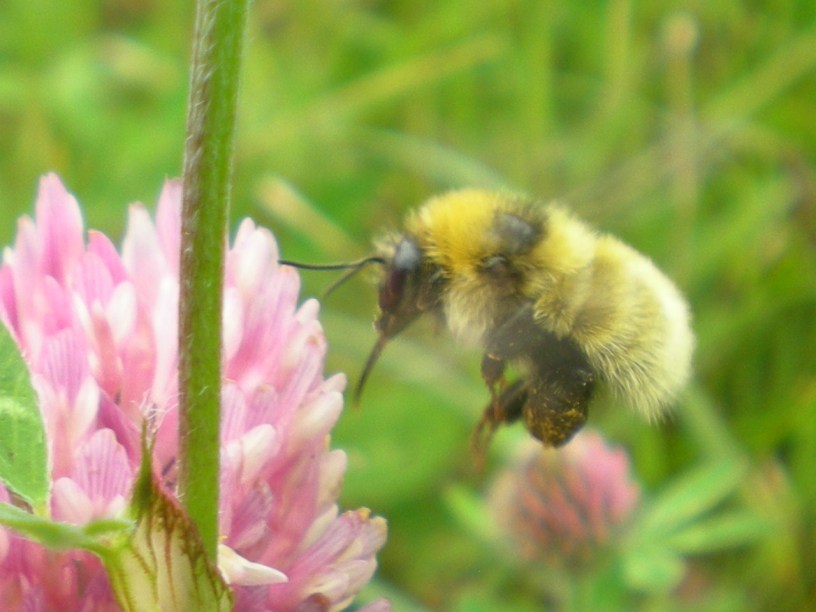
The fate of the Great Yellow Bumblebee (GYB) once common across Ireland, but now confined to a few parts of north-west Mayo, shines a light on the negative impact agriculture has had on many of our native bee species.
“The data shows that GYB populations were more widespread before 1980, while most museum specimens date from the 1920s,” said Dr Dara Stanley, an ecologist at the School of Agriculture and Food, at UCD.
The GYB is now Ireland’s rarest native bumblebee. An attractive species, it is blonde in colour, with a black band across its back. It’s also notable for its long tongue, helping it get nectar out of flowers with long tubes such as red clover.
Starting in the mid-1960s, farmers began making silage instead of cutting grass for hay to feed livestock in winter. This reduced the flowers available for bee species to pollinate, as silage fields produce few flowers.
“In the period 1980 to 2010, the GYB was still in the Burren and in the Shannon Callows, and some other places, but since 2020, the only records have been from the Mullet and one isolated population on Achill Island, which seemed to have disappeared last year,” Dr Stanley said.
Bees’ habitats shrunk further as local authorities began to cut road verges, and homeowners routinely cut the grass
Silage was not the only problem.
Other agricultural practices also affected bees, Dr Stanley said, such as the earlier cutting of hay fields, and intensive summer grazing. This further reduced the flowers and habitat available to the bees such as the GYB.
Bees’ habitats shrunk further as local authorities began to cut road verges, and homeowners routinely cut the grass and used herbicides to control weeds.
All these factors saw the GYB retreat from all corners of Ireland, until it remained only in remote parts of Mayo. It survived there, Dr Stanley said, because of the availability of never-fertilised, species-rich, coastal grassland habitats that were still grazed in winter and left to flower and seed naturally in the summer.
The GYB is not the only native bumblebee that is struggling.
Ireland’s national bumble monitoring scheme reports a decline in bumblebees. Some species remain stable, but others are in severe decline. Meanwhile, data suggests other pollinators like solitary bees and hoverflies are declining too.
“The shrill carder bee and the red-shanked carder bee have declined, but the former still has a healthy population in the Burren where the GYB has disappeared from,” Dr Stanley said.
All is not lost, and there are strategies that Dr Stanley points to that can be adopted to save the GYB, and other bee species.
Mostly importantly, she said, bees need species-rich grasslands to feed in, especially those that have plenty of knapweed, clover and kidney vetch.
“The GYB nests and hibernates in these grasslands, or in the banks at the side of these fields. These habitats can be found on farms, but also in gardens and on road verges, so many different stakeholders can play their part.”
The best thing the public could do to arrest the pollinator declines we are seeing, Dr Stanley said, would be to try to increase the habitat available for them to live in.
There needs to be less cutting of lawns that could act as grassland refuges for pollinators, Dr Stanley said. Homeowners could also help by leaving parts of gardens to grow wild so that flowers and plants there can grow naturally, while also reducing or eliminating the use of weedkillers and bug sprays.
Meanwhile, the message for farmers that still have species-rich grasslands, Dr Stanley said, is that reduced grazing or delayed moving can benefit bees.
“Often there are agri-environment schemes that can help with this. Another key thing is to manage hedgerows and field margins in ways that can increase habitat and allow plants to flower; reducing cutting intensity can be key.”
“We also need to ensure that the GYB doesn’t get exposed to disease from managed bees, or other climate pressures such as pesticide use.”
The stakes involved in trying to save the GYB and other pollinators are huge.
If nothing is done to address the decline of our native pollinators, like the GYB, scientists say it could lead to an ecological collapse, threatening food supplies.
We get all these services from biodiversity without having to even think about it
This has already happened in other parts of the world.
“There are some regions of the world where there are not enough wild pollinators left, and either commercial honeybees have to brought in at great expense or crops have to be pollinated by hand with paintbrushes,” Dr Stanley said.
“Neither of these are sustainable in the long term.”
“We often take biodiversity for granted. We get all these services from biodiversity without having to even think about it. However, it’s only when these services are gone that we’d really realise the problem,” said Dr Stanley.
To find out more about how to save the GYB, and other pollinators, there are guidelines in the All-Ireland Pollinator Plan, which is available online.
 Science Spinning