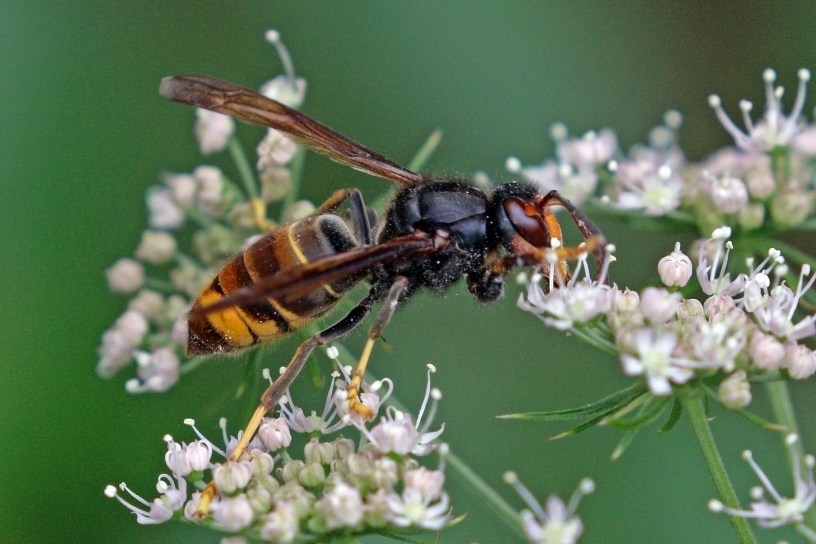
Ireland must ramp up its biosecurity and surveillance measures to prevent invasive Asian hornets devastating bee populations across Europe, an expert has warned.
Collie Ennis, biodiversity officer at Trinity College Dublin, said the insects were a “major threat to Irish biodiversity”, particularly our native bees and pollinators.
“We need enhanced surveillance at ports, public awareness campaigns, stricter biosecurity and a formalised alert network. Speed is critical to avoid establishment,” Mr Ennis said.
The Asian hornet, which preys on honeybees, is native to South-East Asia.
It has a black or dark brown thorax, with a yellow or orange fourth abdominal segment, yellow-tipped legs, an orange face and dark antennae.
It arrived in France in 2004, and then spread throughout western Europe, establishing a presence in Spain, Belgium, Holland, Portugal and Italy. An Asian hornet sighting was first reported in the UK in 2016.
Since then beekeepers, scientists and the British public have worked hard to identify and destroy hornet nests before they can establish a permanent presence there.
However, UK scientists now fear that a dry spring, and a surge in Asian hornet numbers across mainland Europe and the island of Jersey, could increase threat levels. That would also increase the threat to our shores.
There is a lot at stake for the Irish economy. France estimates that it has suffered an estimated €30.8m annually due to bee losses, with beekeepers there forced to spend more than 25pc of their revenue from honey on replacements.
“In Ireland, this could hit our €1.2bn beverage sector, and reduce yields of pollinator-dependent crops like apples and berries, threatening food security by disrupting nutritional diversity, and raising prices,” Mr Ennis said.
The way hornets cause damage to bee populations is by killing worker bees and their brood in order to feed their own larvae.
“This collapses colonies and stresses bees, reducing foraging and causing winter die-offs.”
Asian hornets also eat other pollinators and fruit, causing more damage to ecosystems and agriculture.
An Asian hornets’ nest of 2,000 to 3,000 hornets can eat an estimated 11kg of insects per year.
The hornets also pose a public health risk, through painful stings and rare cases of anaphylaxis, a risk that is worsened by climate change.
The most likely arrival route for Asian hornets into Ireland is through trade, for example in cargo from France on ferries entering Dublin or Rosslare. They could also fly into Ireland from Europe on the wind.
If Asian hornets did land here, it would be vital that the Government initiates a rapid response, experts say.
“If they invade, we’d need rapid nest destruction, public reporting via the National Biodiversity Data Centre (NBDC) and selective trapping,” Mr Ennis said.
The public should avoid approaching Asian hornets, but can help by taking a photograph of them if it is safe to do so – noting the location and reporting it to the NBDC.
 Science Spinning