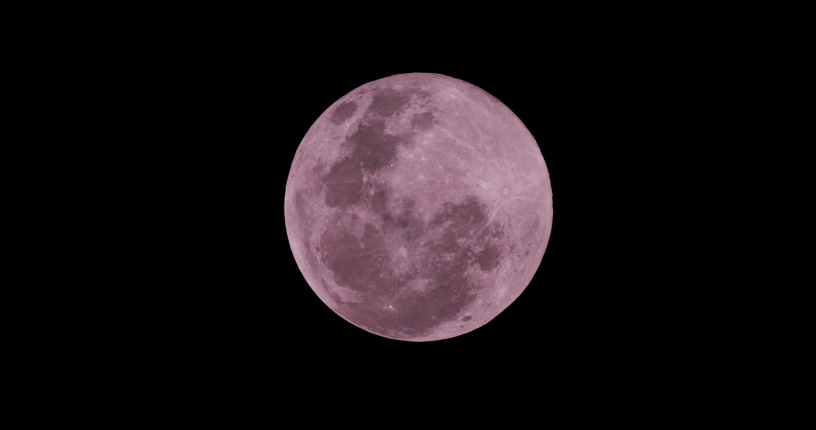
If you are up in the early hours of tomorrow morning watching Netflix, or heading home from a night out, you might look up and see what’s known as a pink moon.
The pink moon is a full moon, but it is not actually pink. The name arose in North America whose native people linked early spring pink wildflowers such as creeping phlox bloom with the appearance of the April moon.
“Native American cultures have given us names like harvest moon and wood moon, which have been adopted by modern culture,” Dr Ray Butler, lecturer in School of Natural Sciences at University of Galway, said.
“Different cultures throughout human history have named constellations and predicted lunar phases to organise their calendars.”
The pink moon, a rare lunar phenomenon, will begin to appear as the sun sets this evening and will reach its “100pc totality” in the early hours of tomorrow. Sky-watchers should not be surprised if the moon looks more orange than pink.
“During rising and setting, the moon looks more orange because the light that it reflects from the sun, and comes in our direction, has to pass through more atmosphere than when it is high in the sky,” Dr Antonio Martin-Carrillo, of the Space Science Group, School of Physics at University College Dublin, said.
Set against the cool blue of dawn, it is remarkable how much you can perceive
He added that when light travels through the atmosphere, the blue colours get scattered first, and this is why the sky appears blue in daytime.
The longer wavelengths of light, the redder colours, are less affected by this “Rayleigh scattering” compared to the shorter wavelengths, the bluer colours.
This means the moon appears orange or reddish when it is low on the horizon, at sunrise or sunset, due to the strong scattering of blue light at those times.
“The colour of the moon depends on the altitude above the horizon, and it is not related to the time of the year,” Dr Butler said.
The terms micro and macro (or “super”) moons refer to how big full moons appear here on Earth. When a full moon is at its farthest distance from Earth, as will be the case tomorrow, it is referred to as a micro moon. When a full moon is closest to the Earth, it’s a macro moon, or “super moon”.
“The terminology micro and macro moon just refers to how we perceive the moon,” Dr Martin-Carrillo said. “The typical size in the sky of a full moon is about 30 arc minutes, or half a degree. However, this value can be a bit bigger, 32 for a macro moon, or a bit smaller, 28 for a micro moon.”
The moon orbits around the Earth in an elliptical orbit, and the point where it is closest to the Earth is called the perigee, while the point where it is farthest away is called the apogee. A micro moon is a full moon that happens at the apogee, he added.
Dr Butler said the size differences between the macro and micro moons are small enough – 7pc bigger or smaller than average – that people won’t tend to notice unless they compare moon photos from different months. Tides are less strong at micro moon.
The exact moment of full moon this month is at 1.22am Irish time and it is also the ecclesiastical full moon before Easter Sunday on April 20.
Easter falls on the first Sunday after the first full moon that occurs on or after the spring equinox. This year, Easter occurs almost as late as it can be. The latest possible Easter date is April 25, which next happens in 2038.
Dr Martin-Carrillo said: “A clear view of the east would help catching the moon rising over the horizon.”
 Science Spinning